01Read
AI-assisted analysis of the codebase, database, jobs and integrations.
You getA system map and a documented inventory of what exists.
Legacy replacement usually fails at the first step: nobody left knows what the system does. We use AI to read and document the code first, then rebuild in slices you can switch on one at a time, with the old system still running until it is safe to retire.
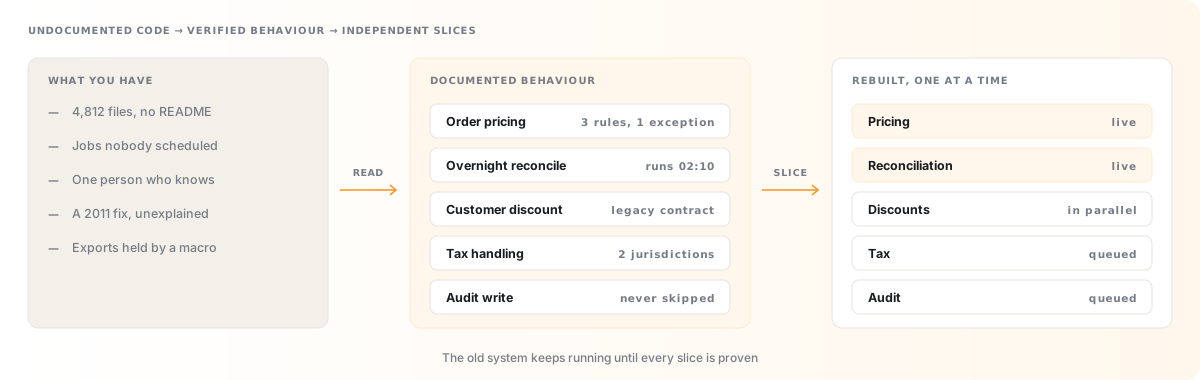
A system that has run the business for fifteen years contains thousands of decisions nobody documented: the discount rule for one large customer, the overnight job that quietly fixes a data problem upstream, the validation that exists because of an incident in 2011.
Rewrite without recovering those and you do not get a modern system. You get a modern system that is subtly wrong in ways your customers find before you do.
Recovering that knowledge used to mean months of manual archaeology, which is why so many of these projects were quoted, feared and shelved. This is the part AI has changed: models can read an entire codebase, trace how data moves through it, and produce readable documentation of what each part actually does.
That does not remove the engineering judgement — it removes the months of reading before the judgement can start. The result is that systems which were uneconomic to modernize are now worth doing.
Four honest options exist for any legacy system, and the cheapest viable one is usually correct. We will argue for the smallest intervention that solves your actual problem.
| Route | When it fits | What it costs you |
|---|---|---|
| Leave it alone | The system is stable, cheap to run, and not blocking anything the business wants to do. | Nothing now, but the skills risk keeps growing quietly. |
| Wrap it in APIs | The logic is sound but nothing else can reach it. Most integration pain is this. | Weeks, not months. The legacy system stays, but it stops being an island. |
| Re-platform | The code is acceptable; the hosting, database or runtime is the liability. | Moderate. Behaviour is preserved, so testing is comparison, not re-specification. |
| Rebuild in slices | The business model has moved on and the system actively prevents change. | The largest option, which is exactly why it is done incrementally, not at once. |
A surprising share of what looks like a modernization problem is really an access problem. The legacy system works; it simply cannot talk to anything built after it. Every new requirement then turns into another export, another overnight file, another spreadsheet that becomes load-bearing.
Putting a well-designed API layer over the existing system solves that for a fraction of the cost of replacing it, and it is not wasted work if you rebuild later, because the new system can sit behind the same contract.
Modernization goes wrong in predictable ways. These are the disciplines that prevent each of them, and we hold to all six regardless of schedule pressure.
The system moves in slices. Each one is small enough that if it misbehaves, you switch that slice back rather than rolling back a quarter's work.
For every slice there is a period where both paths are live and their outputs are compared on real traffic before the old one is retired.
We replay real historical transactions through the new code and diff the results. Matching the specification is not the test; matching reality is.
You receive readable documentation of what the old system did, whether or not you continue with us. That artefact often outlives the project.
Most legacy pain is data pain. We resolve the model before rebuilding the application on top of it, not afterwards.
Your engineers review and commit alongside ours from the start, so knowledge accrues internally, not leaving with us.
AI-assisted analysis of the codebase, database, jobs and integrations.
You getA system map and a documented inventory of what exists.Working sessions where your people correct and complete what the code implies.
You getBehaviour documentation your business has signed off.Slice the system, sequence the work, and identify what can be retired outright.
You getA staged plan with costs, dependencies and a first slice defined.The first slices built, run in parallel and compared against the original.
You getWorking slices in production, with the old path still available.Remaining slices delivered on the same rhythm until the legacy system is switched off.
You getA decommissioning record and the documentation to prove it was safe.The three below are the ones this page does not already answer. Anything more specific, put it to us directly.
It is the normal starting condition, not an obstacle, and it is precisely what the comprehension phase exists to solve. Code is a complete, if unfriendly, record of what a system does; the problem has always been how long it takes a human to read it. We use AI to produce that reading in weeks, then put it in front of the people who use the system daily. They cannot tell you how the code works, but they can immediately tell you when the documented behaviour is wrong, which is the check that matters. The hard cases are not missing developers but missing source code, or a build nobody can reproduce.
Yes, and you should — a modernization that freezes the business for a year is one the business will eventually cancel. Because the work moves in slices, feature development continues on the parts not currently being moved. What we do ask for is a short freeze on the specific slice in flight, usually two to three weeks, to avoid chasing a moving target. Where a feature must land in a slice mid-flight, it gets built in the new code instead of the old, which is generally faster anyway.
By replaying your own history through it. We take real historical transactions (orders, claims, calculations, whatever the system processes) run them through both the legacy path and the new one, and compare the outputs field by field. Differences are then triaged into bugs and deliberate corrections, because some of what the old system does is wrong and has been quietly wrong for years. That comparison report is the evidence your risk function will want, and it is far more convincing than a test plan.