
Most of the cost sits in the middle of the claim.
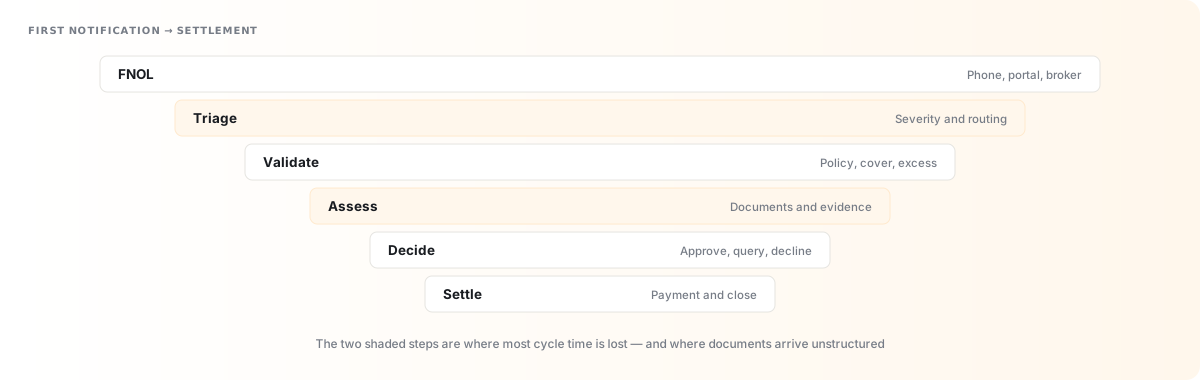
First notification is cheap. Settlement is cheap. Everything between them (validating cover, chasing documents, assessing evidence, deciding) is where cycle time, leakage and customer frustration all accumulate.
Nobody complains about the claims that go straight through.
Straight-through processing rates are the number everyone reports, and they hide the problem. The claims that flow through cleanly were never expensive. The cost is concentrated in the ones that fall out, missing documents, ambiguous cover, evidence that arrives as photographs and a phone call.
Those cases consume adjuster time, drive the complaint volume, and are also where leakage happens, because under pressure the cheapest resolution is often to pay rather than investigate.
The useful intervention is not a higher straight-through rate. It is making the fallout cases faster to work: the documents already read and structured, the policy position already stated, the comparable history already assembled, and the specific question the adjuster needs to answer made explicit.
That is assisted decision-making rather than automated decision-making, and in this sector that distinction is both commercially and regulatorily the right one.
The same claim, worked differently.
The adjuster starts from nothing
- Documents arrive by email and sit unread in a queue
- Cover position established by reading the wording again
- Comparable claims found only if someone remembers one
- Chasing the customer for what was already supplied
- Cycle time measured in weeks, cause unclear
The adjuster starts from a prepared case
- Documents read, classified and matched to the claim on arrival
- Cover position stated with the clause cited
- Comparable settled claims surfaced automatically
- Missing items requested once, immediately, and tracked
- Cycle time reported per step, so the blockage is visible
Six pieces of insurance work we do repeatedly.
Claims intake & document extraction
Reading forms, invoices, reports and photographs into structured data with confidence scores and a review queue.
Email · portal · document storeTriage & routing
Severity, complexity and specialism assessed on arrival so a claim reaches the right desk first time.
Claims system · policy adminCover position assistance
The relevant policy wording surfaced and cited, so the adjuster confirms rather than researches.
Policy wordings · endorsementsUnderwriting support
Submission data assembled and enriched, with the exposures a underwriter would want flagged before they open the file.
Submissions · external data · pricingPolicy administration modernization
Moving off policy admin platforms that are stable but unmaintainable, without stopping renewals.
Legacy PAS · ledger · broker portalsRegulatory & conduct reporting
Recurring submissions assembled from live data with the lineage of each figure recorded.
Warehouse · BI · regulator returnsSix controls that keep an assisted claim defensible.
The adjuster decides
The system prepares, cites and recommends. Declines, settlements and payments remain a human determination with a named owner.
Every extraction is traceable
A structured field always links back to the page and passage it came from, so a disputed figure can be checked in seconds.
Confidence drives review
Low-confidence extractions go to a queue, not into the record. The threshold is yours to set and to move.
Nothing is silently overwritten
Automated updates to a claim are recorded as such, distinguishable from a human edit in the audit trail.
Customer data stays scoped
Retrieval inherits your existing entitlements; a handler sees the claims they are entitled to see and nothing more.
Performance is measured on outcomes
Cycle time, reopen rate and leakage, not model accuracy, which tells you almost nothing about whether the claim was handled well.
Before you automate claims.
Three questions we are asked by almost every insurance client.
Will this let us reduce adjuster headcount?
That is the wrong first question, and answering it matters more than selling the project. In most books we see, the constraint is not headcount but cycle time and consistency; a backlog growing faster than the team can clear it, and experienced adjusters spending half their week on data entry. Preparing the case, not deciding it typically takes a meaningful share of that handling time out. Whether you convert that into fewer people or faster settlement is a decision for you, and it is worth making it explicitly before the project, not after.
Our policy wordings are in PDFs going back fifteen years. Is that workable?
Yes, and it is the normal starting condition. What matters is not the format but whether anyone can say which wording applies to which policy, version control on wordings is the more common blocker. We ingest the documents, extract the structure and link each wording to the policies it governs; where the mapping is genuinely unknown we surface that as a gap rather than guess, because a confidently wrong cover position is far worse than no answer.
How do we handle the regulator's view of automated decisions?
By keeping the determination with a person and being able to prove it. Our default design has the system assembling evidence, citing the wording and recommending, with the adjuster recorded as the decision-maker. That distinction is visible in the audit trail rather than asserted in a policy document. Where you want more automation on low-value, high-volume claims, that becomes an explicit decision with its own threshold, monitoring and review, not a silent extension of scope.