Home/Build & Run/Hire Developers
Build & Run

Named engineers you interview, not a capability statement.

Every profile we send is a specific person with a CV and a reference. You interview them, you can decline them, and the arrangement is monthly rolling with thirty days notice. That is the whole commercial model.

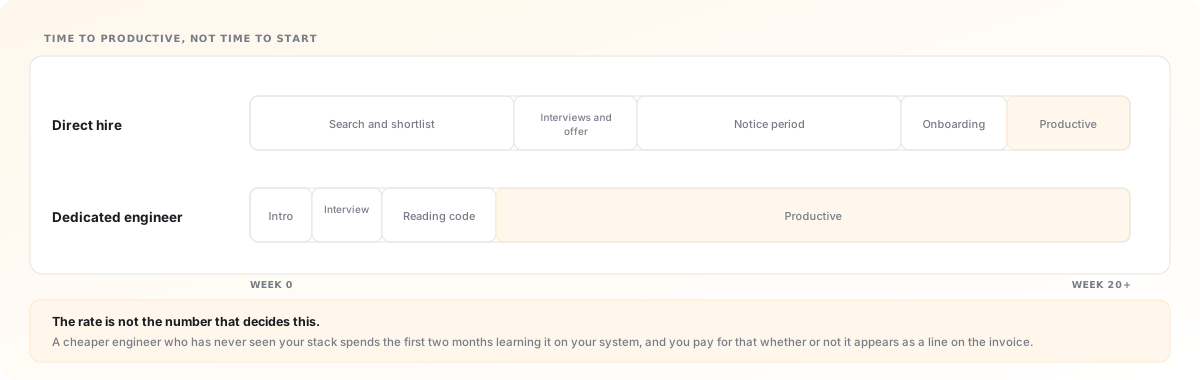
Time to productive compared for a direct hire and a dedicated engineer
Delivering since2003StartIntroductions in about a weekCommitmentMonthly rolling, 30 days noticeInterviewYou meet them, you can declineOverlap4–6 hours with US and EUScaleOne engineer to a full team
Sixteen roles with a page each

What we staff, and what makes each hire different.

Every one of these has its own page, because the thing that decides a good hire is different in each case, and a page that could be produced by changing one word is worth nothing to you.

AI & data

Where the brief most often describes the wrong role.

Back end

Framework and estate matter more than the language.

Front end

Where practice from 2019 still passes an interview.

Mobile

Shipping to a store is the skill, not building the app.

Cloud & platform

Developer, DevOps and architect are three different hires.

How much, and for how long

Four shapes. Most engagements move between them.

You are not committing to a direction by starting. Moving up or down is a conversation, not a renegotiation.

ShapeSuitsCommitment
Fractional, a few days a monthA stable system that needs patching, small changes and somebody who knows itMonthly rolling
One dedicated engineerActive development, a backlog, or covering a departureMonthly rolling, 30 days notice
Small team — two to fourA product with a roadmap, or unfreezing a system nobody dares changeRolling, reviewed quarterly
Team plus delivery leadYou want accountability for an outcome instead of capacityProject plan, staged
From first message to somebody starting

What happens after you send us a brief.

Day 1–2

01We ask what the work is

Not the job title. What the code has to do, what it runs on, and who will maintain it. This is where we most often tell people they need a different role from the one they asked for.

You get; an honest view on the role, free
Week 1

02Profiles with CVs

Named individuals, with their two strongest areas stated plainly and the gaps stated too. Not a bench summary.

You get— two or three profiles, usually
Week 1–2

03You interview them

Technically, however you like, with your own team. You can decline anybody without explanation and we will come back with others.

You get, your process, not ours
Week 2–3

04They start reading

Comprehension first. An engineer who has not read your system is not yet useful on it, and pretending otherwise is how the first month gets wasted.

You get, a written view of your codebase
Ongoing

05In your rituals, not ours

Your stand-ups, your board, your channels, your definition of done. Monthly reporting on what changed and what we would fix next.

You get, capacity that works to your priorities
The commercial questions

What we would want to know if we were buying this.

We would rather answer these before you ask. If you are comparing suppliers, they are worth putting to all of them; the answers vary more than the rates do.

  • Named individuals, not a pool. You get a specific person and a named second who also knows your system. Accumulated context is the entire value here, and a rotating queue destroys it by design.
  • You interview, and you can say no. Without explanation and without it becoming a negotiation. A supplier who resists this is telling you something.
  • Monthly rolling, thirty days notice. No multi-year commitment and no exit fee. If we are not earning it, leaving should be easy.
  • Quiet months carry forward. Within the term. Demand is lumpy, and a contract that punishes you for a quiet quarter encourages exactly the wrong behaviour.
  • Everything we write is yours. Code, documentation and decisions live in your repository, not our wiki. If the relationship ends, the knowledge does not leave with us.
  • We will tell you when to stop. If the work is done, or better brought in house, we will say so. A retainer that quietly outlives its usefulness is bad business for both sides.
  • Rates on request, and they are boring. Broadly one band across our engineers regardless of technology, because they are largely the same people. What changes the cost is seniority and how many, not which language.
Staffed, but without a page of their own

Roles we field that did not need a page.

The live site had a page for each of these. They said very little that this block does not, so they now point here, which is more honest and more useful than fifteen hundred words of the same paragraph rearranged.

  • UI and UX designers. Product design, design systems and accessibility, usually alongside a front-end engineer, not instead of one. Most often engaged part-time.
  • QA and test automation engineers. Regression suites for systems that have never had them, plus API and UI automation in your pipeline. Frequently the highest-return hire on a legacy estate.
  • Security engineers and analysts. Application security review, hardening and remediation work — see also cybersecurity.
  • Solution and enterprise architects. Usually weeks rather than a permanent role: target architecture, integration design, and a costed migration plan. Then a few days a month.
  • PHP, Laravel and the older JavaScript stacks. Covered under full-stack developers, where they sit more naturally than as pages of their own.
  • Forward deployed engineers. Not a separate skill so much as a way of working: an engineer embedded in your context and accountable for the outcome. It is how we staff AI and modernization work by default, and it is priced the same as any other engineer.
  • Delivery leads and scrum masters. Part-time, where you want somebody accountable for an outcome, not for capacity.
Questions worth asking

Hiring through us.

The commercial questions, answered once, here.

How is this different from a staffing agency?

An agency introduces you to a person and takes a fee; after that the relationship is between you and them, and if it does not work out you start again. We remain accountable for the work. That means a named second engineer who also knows your system so absence is covered, peers our engineers can escalate to, not being alone on your problem, and a replacement at our cost if somebody is not working out rather than at yours. It also means we will tell you when the honest answer is that you do not need us, which is not a conversation an agency is structured to have.

What about time zones?

Our engineers work a shifted day that gives four to six hours of overlap with US and European working hours, and that overlap is protected, not best-effort, stand-ups, reviews and anything needing a conversation happen inside it. What changes is that you stop expecting an instant answer at any hour, which most teams adapt to within a fortnight and some find improves how they write things down. If your work requires eight hours of overlap, say so early; there are arrangements that get closer, and they cost more, and we would rather price it than have you discover the constraint in month two.

Can we hire the engineer permanently later?

Yes, and we would rather have that conversation openly than pretend it does not happen. If an engineer has become central to your business and both they and you want it to be permanent, blocking it serves nobody, we would agree terms and help with the transition. What we will not do is present someone as a dedicated engineer while quietly treating the engagement as a recruitment pipeline, which is a common pattern in this market and one worth asking every supplier about directly.

What if the person is not working out?

Tell us early, and specifically. Most of the time it is fixable and it is usually not a capability problem, unclear priorities, a gap in context nobody filled, or a mismatch between the work and what the person is strong at. If it is not fixable we replace them at our cost, and the second engineer already knowing your system is what makes that a handover rather than a restart. What we would ask is that you raise it in week three, not month three; by then the frustration has usually hardened into a decision and everyone has lost something.