
An unsupported engine is a dated risk, not a vague one.
When a ColdFusion version leaves support, newly published vulnerabilities stop being fixed for you. The exposure that follows is well documented and largely closable, usually in days, not quarters.
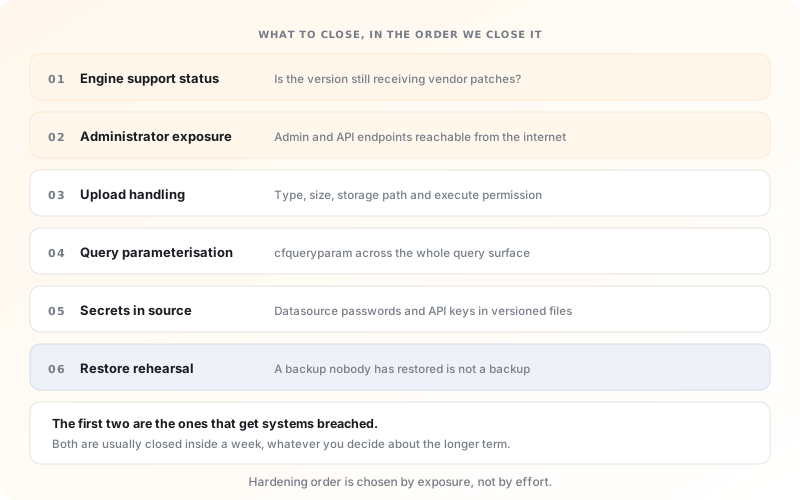
Six surfaces, ranked by exposure rather than by effort.
Security work on legacy platforms goes wrong when it is sequenced by what is easy. The first two items on this list account for the overwhelming majority of documented ColdFusion compromises, and both are usually closed inside a week.
Engine support status comes first because it is binary and it governs everything else. On a version past end of support, newly disclosed issues will not be fixed for you, and no amount of application-level care compensates for that.
Administrator exposure is second and is the one that surprises people. The CF Administrator and its associated endpoints being reachable from the public internet is common, rarely intentional, and closable with a configuration change.
The remaining four are application-level and take longer, but they are ordinary engineering work with a clear finish line, and they are the ones that show up in an audit.
Six practical consequences, none of them theoretical.
Adobe publishes a support lifecycle for each ColdFusion release. Confirm your version against Adobe's current published dates, and then read this list, because the consequences are the same whichever version you are on.
New vulnerabilities stop being fixed for you
Issues disclosed after end of support are not patched on your version. The gap widens every month, and it only moves in one direction.
Disclosure works against you
Details of fixed issues are published so that supported users can act. On an unsupported version, that same publication is a description of your exposure.
Your insurer and your auditor will ask
Unsupported software in the critical path is a standard question on cyber insurance renewals and security questionnaires. A dated remediation plan is a much better answer than a promise.
Customer security reviews will find it
Enterprise procurement increasingly asks for a software bill of materials. This is turning up in sales conversations, not just IT ones.
Compensating controls help, but do not substitute
A web application firewall and tight network segmentation reduce risk and we will help you put them in. They do not close the underlying gap and should not be presented as though they do.
The upgrade gets harder the longer it waits
Each skipped version adds behaviour changes to work through. The cheapest engine upgrade available to you is the one you start this quarter.
One week, and the urgent things are already closed by the end of it.
-
Day 1
Establish the facts
Engine version and patch level, hosting arrangement, what is reachable from outside, and where the application runs. Surprising how often the last of those is not fully known.
-
Days 1–2
Close the exposed surfaces
Administrator and API endpoints restricted, unnecessary services turned off, default paths dealt with. We do this immediately, not putting it in a report, because a week of unnecessary exposure is a week too long.
-
Days 2–4
Read the code for the known classes
Query parameterisation, upload handling, session and authentication logic, secrets committed to source control. Findings are ranked by exploitability, not by how many there are.
-
Day 4
Test the restore
Not the backup, the restore. This is the control most often assumed and least often verified, and it matters more on a platform with a shrinking pool of people who could rebuild it.
-
Day 5
Ranked plan, with effort against each item
What we closed, what remains, what each remaining item would cost, and a clear recommendation on whether the answer is an engine upgrade, a move to Lucee or a staged migration.
Four routes out, in ascending order of cost.
The review tells you which one you need. Most organisations take the first or the second, and the review is designed to make that decision defensible, not to steer it.
Written up in more depth on the blog.
Longer-form background on the hardening work described above.
Security, end of life, and what to do first.
Written for the person who has just been asked about this by their board.
How urgent is this really?
It depends almost entirely on one thing: whether the application is reachable from the public internet. An internal ColdFusion application behind a VPN on an old engine is a real risk that should be scheduled, and you have time to plan it properly. The same application published to the internet on an unsupported engine, with the administrator interface reachable, is a different conversation and should be looked at this month. The reason we sequence the review the way we do is that the difference between those two situations is usually a configuration change, so the fastest available risk reduction is available in the first two days rather than at the end of a project.
Can we just put a firewall in front of it and move on?
A web application firewall is worth having and we will help you configure one, but it should be understood as buying time, not closing the gap. Generic rules do not reliably stop attacks against application-specific logic, and an unsupported engine accumulates new unpatched issues continuously, so the thing the firewall is compensating for keeps growing. Where it earns its place is as the first move in a plan, deploy it, restrict the administrator surface, then upgrade the engine over the following quarter. Where it becomes a problem is when it is presented internally as the solution, because that ends the funding conversation and the underlying exposure is still there two years later.
Our auditors have flagged unsupported software. What do they want to see?
In our experience, a dated plan with named owners, more than an immediate fix. Auditors and insurers are generally realistic about legacy platforms; what they react badly to is an absence of evidence that the organisation understands and is managing the risk. A one-week review that produces a written inventory, a ranked findings list, a record of what was closed and when, and a costed remediation plan with dates against it will usually satisfy the question, even where the engine upgrade itself is still months away. We write the output with that audience in mind for exactly this reason, the document has to be usable by somebody who is not an engineer.