
Engineers who stay long enough to know your systems.
The value of an external team is entirely in continuity. People who have worked on your platform for two years are worth several times a rotating pool, and that is the difference between this and conventional outsourcing.
You were sold a team. You received a queue.
The standard outsourcing failure is rotation. Engineers are assigned by availability rather than by relationship, someone new appears every few months, and each one spends their first six weeks learning what the last one knew. The client ends up paying for the same onboarding repeatedly and wondering why velocity never improves.
The second failure is a ticket queue in place of a team. Work goes in, output comes back, and nobody on the supplier side ever forms a view about the product or pushes back on a bad requirement.
We run it the other way. Engineers are named, they stay on the account, and they join your stand-ups, not reporting through an account manager. Over time they accumulate exactly the context that makes an internal hire valuable.
That also means we will occasionally tell you a request is a bad idea. A supplier who only ever agrees is a supplier who has stopped paying attention.
Forward deployed engineering, which is what we have always done.
The term comes out of the AI world and it describes an engineer embedded in your context, accountable for the outcome, not a resource assigned to a queue. We have worked this way since 2003; the industry has only recently agreed on a name for it.
Embedded in your context, not ours
Your stand-ups, your backlog, your repository, your definition of done. The engineer learns your business, not a specification of it.
Accountable for the outcome
A forward deployed engineer is measured on whether the thing works in your hands. A contractor is measured on whether the ticket was closed. That difference decides what somebody does when the ticket is wrong.
Allowed to disagree
The value of an embedded engineer is largely in the requirements they push back on. A supplier who only ever agrees has stopped paying attention.
Present for the last mile
Most of the difficulty in an AI or modernization project is in the final twenty per cent, where the system meets real data and real users. That is the part a remote ticket queue handles worst.
Continuity is the mechanism
None of this works with rotation. It only works if the same person is still there in a year, which is why we staff for tenure over utilisation.
Where it does not apply
Some work is capacity against a clear backlog, and that is a perfectly good arrangement. We will tell you which one your brief is, because paying forward deployed rates for ticket work is a waste of your money.
Four ways to work with us.
Most relationships start narrow and widen. Nothing here requires a multi-year commitment to begin.
| Model | When it fits | How it works |
|---|---|---|
| Dedicated team | You have a backlog and need capacity that accumulates knowledge, not resetting. | Named engineers, monthly per person, working to your priorities. Thirty days' notice. |
| Managed service | A system needs running, patching and supporting, not actively developing. | Agreed response and resolution targets, named engineers, monthly reporting. |
| Project delivery | A defined outcome with a date, where you would rather buy the result than the capacity. | Fixed price against an agreed scope, delivered in reviewable increments. |
| Advisory | You need a second opinion, an architecture review or help choosing between options. | Days or weeks, fixed price, with no expectation of build work afterwards. |
Six roles we most often place.
Teams are usually mixed. A common shape is two engineers, a part-time architect and shared QA, adjusted as the work changes.
Full-stack engineers
Frontend and backend across the stacks we work in, from mid-level through to lead.
React · Node · .NET · Java · PythonCloud & DevOps engineers
Infrastructure as code, pipelines, observability and cost control.
AWS · Azure · Terraform · KubernetesData engineers & analysts
Pipelines, warehouse modelling and reporting on a governed semantic layer.
SQL · Python · Power BI · dbtAI & ML engineers
Agents, retrieval systems, model integration and the evaluation harnesses around them.
Python · LLM APIs · LangChainQA & test automation
Test strategy and automation that the delivery team trusts rather than routes around.
Playwright · Cypress · performanceArchitects & tech leads
Part-time senior oversight where a team needs direction more than another pair of hands.
Design · review · mentoringSix commitments that make a distributed team workable.
Distance is manageable. Ambiguity is not. These are the practices that keep an external team functioning like an internal one.
You choose the people
Candidates are interviewed by you and you decline the ones you do not want, exactly as you would for a permanent hire.
Named, not pooled
The same engineers stay on your account. If someone must change we give notice and run a proper handover instead of a substitution.
Your process, not ours
We join your stand-ups, your board, your repository and your definition of done. We do not run a parallel process and report into it.
Overlap hours guaranteed
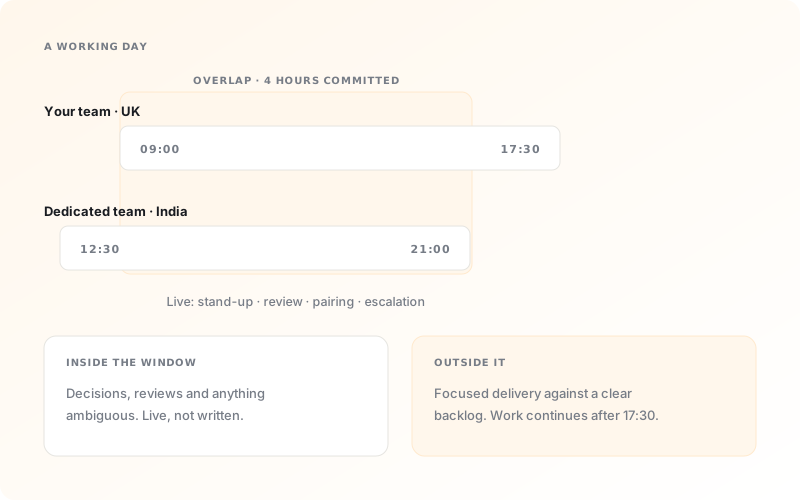
A committed window each day that overlaps your working time, agreed at the start rather than negotiated per meeting.
Direct communication
Your people talk to the engineers. An account manager exists for the commercials, not as a filter on technical conversation.
Thirty days' notice
Scale down or stop with a month's notice. A supplier who needs a long lock-in is telling you something about their confidence.
The stacks we staff.
If something you need is not listed, ask — the list reflects where we have depth instead of the limit of what we will work in.
Backend
Service and API engineers on all six platforms.
Cloud & DevOps
Platform and delivery engineering.
Data
Pipelines, modelling and database engineering.
AI & ML
Agent, retrieval and model engineering.
Sixteen roles, each with a page of its own.
What separates a good hire from an average one is different in every one of these, so each has its own page rather than a paragraph here.
Before you extend your team.
The three below are the ones this page does not already answer. Anything more specific, put it to us directly.
How is this different from hiring contractors directly?
Mostly in what happens when something goes wrong or someone leaves. A direct contractor is your responsibility to source, vet, replace and cover; if they resign mid-project the gap is yours. With a dedicated team, replacement, holiday cover and escalation to more senior engineers when a problem exceeds the team's experience are ours to solve. The trade-off is cost per head: a direct contractor is often cheaper on paper, and genuinely is if you have the management capacity to run them and the tolerance for the gap when they leave. For one specialist for three months, hire directly. For sustained capacity, the arithmetic usually goes the other way.
What happens to our code and knowledge if we stop?
Nothing changes hands, because nothing was ever held. Code lives in your repositories, infrastructure in your cloud accounts, and documentation in your systems from the first day. We write documentation as we go specifically so that an exit is not a special project, and we expect your engineers reviewing our pull requests throughout, which is the real transfer mechanism. At the end of an engagement we run handover sessions with whoever takes over. Clients who have stopped and later restarted are a meaningful share of our work, and that only happens if leaving was straightforward.
Will time zones be a problem?
They are a constraint to design around instead of a problem, and the difference between arrangements that work and ones that do not is whether the overlap was agreed explicitly. We commit to a fixed daily window that overlaps your working hours, typically the afternoon in India against the morning in the UK, or an early start against US Eastern time. Inside that window meetings, reviews and pairing happen live. Outside it the team works asynchronously against a clear backlog, which is why written clarity in tickets matters more here than it does with a co-located team. Most clients find the offset useful once it settles: work continues after their day ends.