
You cannot migrate ColdFusion to React. You can split them apart, which is better.
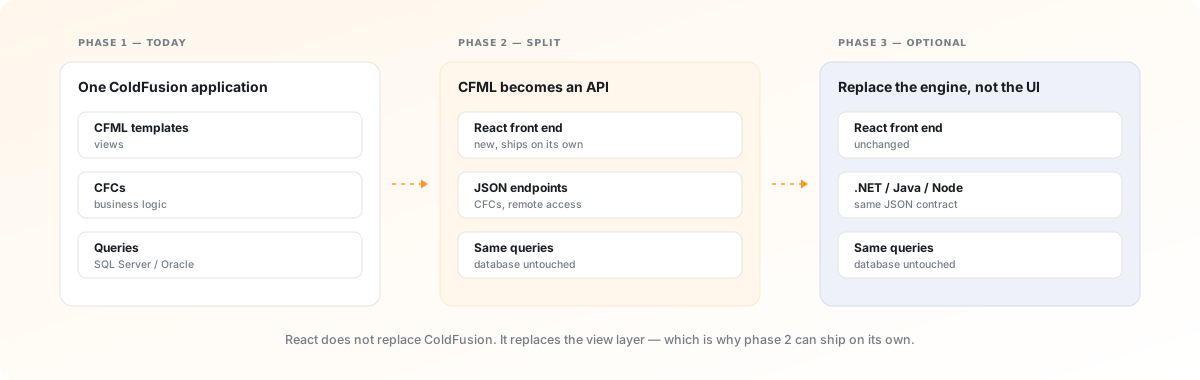
React replaces your view layer, not your platform. That distinction is the whole opportunity: you can modernise what users actually complain about without touching the engine, the database or the business rules.
The search term is wrong, and the instinct behind it is right.
People search for “ColdFusion to React” because the ColdFusion application they use every day looks and feels like it was built in 2006. They are not wrong about the problem. They are describing a symptom in the vocabulary of the fix they have heard of.
React is a front-end library. It renders interfaces in a browser. It does not run queries, hold transactions, send mail or enforce business rules, all of which your CFML is currently doing. There is no version of this where React replaces ColdFusion, and any proposal that implies otherwise is selling you a rewrite with a friendlier name.
What you can do (and what usually delivers most of the value people wanted) is separate the two concerns your CFML currently mixes. The business logic keeps running in ColdFusion. The screens are rebuilt in React and talk to that logic over JSON.
The result is that the thing everyone complains about gets fixed in a quarter rather than a multi-year programme, the platform risk stays exactly where it was, and if you later decide to replace the back end, the React front end does not change at all. You have turned one irreversible decision into two reversible ones.
What sits where, after the split.
The boundary is a JSON contract. Everything above it is new, everything below it is what you already own and have already paid for.
access="remote"returnformat JSONExisting validationSix steps, and you can stop after any of them.
Each step leaves you with a working system and a decision, instead of a commitment to the next one.
What the first eight weeks look like.
One screen, end to end, so the approach is proven on something real before anybody commits to a programme.
-
Weeks 1–2
Choose the screen and read what feeds it
Usually the highest-traffic screen with the loudest complaints. We trace every CFC, query and include behind it, because the boundary can only be drawn accurately once you know what is being called.
-
Week 2
Define the JSON contract
Written down and agreed before either side is built, so the front end and the CFML work can proceed in parallel instead of one waiting on the other.
-
Weeks 3–4
Expose the CFCs
Existing components given remote access with JSON return, authentication wired to the same session or a token, and contract tests written from the React side so regressions surface in CI rather than in the browser.
-
Weeks 4–7
Build the screen
React, TypeScript and a small design system that the rest of the application will inherit. This is where the visible improvement happens, and where users first see that the system is being looked after.
-
Week 8
Run both, then switch
The new screen and the old one live simultaneously on different routes. Users move when you are ready, and the old route stays available until nobody is using it.
Written up in more depth on the blog.
The same argument, worked through at greater length.
Front end, back end, and what this does not solve.
Including what this approach deliberately leaves unfixed.
If we do this, have we solved the ColdFusion problem?
No, and it is important to be direct about that. Splitting the front end fixes the experience your users have and buys you a great deal of time, but every underlying risk on the ColdFusion side is exactly where it was: the engine still needs to be patched, the hosting still needs to be sourced, and the maintainer population is still shrinking. What changes is that you now have a clean contract between the interface and the logic, which makes the eventual back-end decision dramatically cheaper; the front end does not change at all when the engine behind it does. Think of it as fixing the urgent problem while making the important one easier, not as making the important one go away.
Can our ColdFusion actually serve JSON properly?
Yes. CFCs have supported remote access with JSON return for many years, and for most applications the endpoints can be built from components that already exist rather than written from scratch. The work is rarely in the serialisation. It is in the two things either side of it: authentication, because a browser-based front end needs a token or cookie strategy that fits how your users sign in, and shape, because a CFC written to feed a server-rendered page often returns exactly what that page needed and nothing more. Getting the contract right is a design exercise. Making CFML emit JSON is not.
Why not Vue, or Angular, or just modernise the CFML templates?
Any of those can work, and the last one is under-considered. If the complaint is that the screens look dated instead of that they behave badly, a careful pass over the existing templates with a modern stylesheet will get you a surprising distance for a fraction of the cost, and we will tell you when that is the better buy. Where a front-end framework earns its place is when the interface needs to be genuinely interactive, live filtering, partial updates, complex forms with interdependent fields. Between React, Vue and Angular the technical differences matter far less than which one you can hire for in your market. React usually wins that on volume alone, which is why it is the default here instead of because of any architectural superiority.