
The order was the easy part.
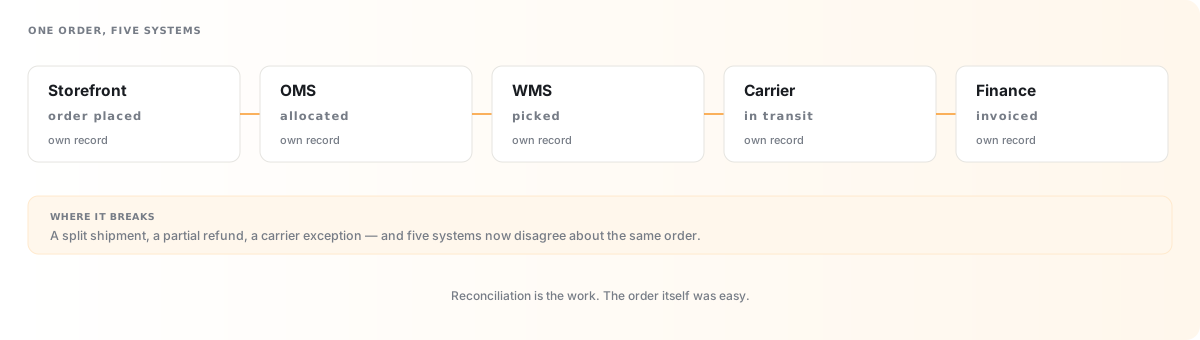
Taking payment is a solved problem. What breaks is everything after it, the split shipment, the partial refund, the carrier exception, and five systems that now disagree about the same order.
One order, five systems, five versions of the truth.
Each system in the chain is individually correct and collectively inconsistent. The storefront knows what was ordered, the warehouse knows what was picked, the carrier knows what moved, and finance knows what was invoiced, and on any non-trivial order those four facts differ.
Most retail engineering effort goes into reconciling that, usually as a growing pile of scheduled jobs and a spreadsheet somebody maintains. Making the reconciliation explicit, monitored and exception-driven is the highest-return work available in this sector.
Six pieces of retail work we do repeatedly.
Order management & orchestration
One place that knows the state of every order, including the ones that split, part-refund or fail at the carrier.
OMS · WMS · storefront · financeInventory accuracy
Reconciling stock across channels and locations so the number customers see is the number you have.
WMS · ERP · marketplacesDemand forecasting
Predicting what to hold where, which is one of the strong cases for a model over a reorder rule.
Sales history · seasonality · promotionsStorefront & checkout
Conversion-focused front ends that hold up on a slow connection and an older phone.
Custom · headless · WooCommerceCustomer service automation
Where-is-my-order, returns and exchanges handled end to end, escalating anything that needs a judgement.
Ticketing · OMS · carrier APIsPeak readiness
Load testing, caching and failure design for the trading day that decides the quarter.
CDN · queueing · autoscalingRetail has more automatable work than most sectors.
Volume is high and the cost of an individual error is usually low, which moves more of the grid into autonomous territory than we would accept in banking or health.
Rules with a check
Pricing changes, promotional logic and anything customer-visible at scale. Deterministic, with a person confirming the release.
Assisted, person decides
Fraud review, high-value disputes and supplier claims. The case is assembled automatically; the decision is not.
Automate outright
Order status, tracking updates, straightforward returns. High volume, well bounded, and cheap when occasionally wrong.
Agent with escalation
Service enquiries and exception handling; the routine majority cleared, the difficult tail routed to a person with context.
Before you rebuild your stack.
Three questions we are asked by almost every retail client.
Should we replatform or fix what we have?
Usually fix, and specifically fix the integration layer instead of the storefront. Replatform projects are attractive because the storefront is the visible part, but in most retail estates the storefront is not what is failing, the reconciliation between order, inventory and finance is. Replatforming without addressing that gives you a better-looking front end on top of the same inconsistency. We would look at where your exceptions come from before recommending anything with the word platform in it.
Is demand forecasting worth it at our size?
It depends on how much capital is sitting in stock and how seasonal your range is, not on revenue. The prerequisites are a couple of years of clean sales history, a genuinely repeated decision, and someone who will act on the output. Below a certain range complexity a good reorder rule and a clear report will beat a model and cost a fraction as much to run. We will look at your data and tell you which situation you are in, not assuming the model is the answer.
Can you work with our existing agency or platform partner?
Yes, and it is common. Frequently the agency owns the storefront and the customer experience while we work on the systems behind it, order orchestration, integration, reconciliation and data. That split works well because the skills differ. What we would ask for is a clear contract between the layers so neither side is guessing about the other's behaviour.