01Assess
Current pipeline, infrastructure, test coverage, lead time and failure rate measured.
You getA baseline and a prioritised list of what is costing you most.
A deployment that needs a weekend, a runbook and three people on a call is a design problem. We build infrastructure as code and pipelines that test, scan and deploy on every merge, so a release becomes an ordinary Tuesday afternoon.
Release anxiety is a symptom instead of a discipline problem. Teams batch changes because releasing is painful, which makes each release larger, which makes it riskier, which increases the anxiety. The loop tightens until deployment happens monthly and each one is a project.
Breaking it means making the individual release small and unremarkable: automated testing that people trust, a pipeline that runs the same way every time, and a rollback path that has been used.
The same principle applies to infrastructure. A resource created by hand in a console is one nobody can reproduce, review or safely delete, and estates accumulate hundreds of them.
Everything in code, in a repository, changed through a pull request. That is not purism; it is the only way an environment can be rebuilt after a bad day, and the only way a security review can be answered in less than a fortnight.
The point of a pipeline is not speed, though it usually delivers that too. It is that the same checks run the same way on every change, so quality stops depending on who reviewed it and how tired they were.
Security belongs here rather than in an annual test. Dependency scanning, secret detection and infrastructure policy checks are cheap on the merge that introduced the problem and expensive six months later.
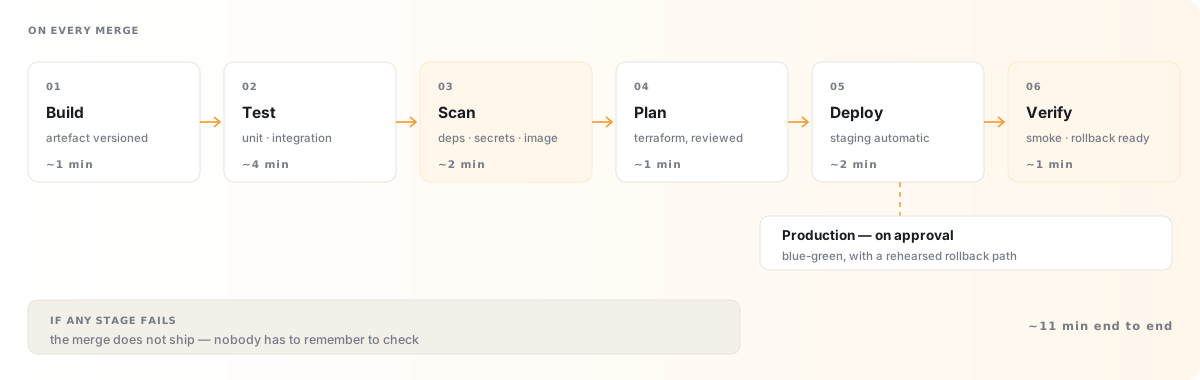
The failure mode in test automation is not too few tests. It is a suite that fails intermittently, which teaches everyone to re-run it and eventually to ignore it. A flaky suite is worse than no suite, because it consumes time and provides false comfort.
We would rather have three hundred tests that are always right than three thousand that are usually right. That means fixing flakiness as a priority defect, keeping the pyramid weighted toward fast unit tests, and reserving end-to-end coverage for the handful of journeys that must not break.
Most estates have monitoring. Far fewer can answer why something was slow last Tuesday, which is the question that gets asked.
Alerting on user-visible symptoms, not on every resource metric. An alert nobody acts on trains people to ignore the ones that matter.
Distributed tracing so a slow request can be followed through every hop rather than guessed at from separate logs.
Correlation IDs and structured fields, so an investigation is a query rather than an afternoon of grep.
The person woken at 3am gets the context and the first three steps, not just a red notification.
A documented rollback nobody has executed is a hypothesis. We test it as part of delivery.
Incidents produce changes to the system, not to the individual, or the same incident returns with a different name.
Multi-cloud in capability, single-cloud in advice — go deep on the platform your organisation can genuinely operate.
Reproducible infrastructure and workload hosting.
Managed database services, backup and availability design.
The workloads the platform exists to run.
Current pipeline, infrastructure, test coverage, lead time and failure rate measured.
You getA baseline and a prioritised list of what is costing you most.Landing zone, identity, tagging and the security baseline, all defined as code.
You getA reproducible environment and the repository that defines it.Build, test, scan and deploy automated end to end, with approval gates where needed.
You getReleases that run on merge, with a rehearsed rollback path.Metrics, tracing, structured logging and alerting that maps to user impact.
You getDashboards and alerts your on-call team will actually use.Your engineers operating it, with us available, not in the way.
You getDocumentation, runbooks and a team that no longer needs us.The three below are the ones this page does not already answer. Anything more specific, put it to us directly.
Probably not, and we say that as people who run it for clients who do. Kubernetes solves problems of scale, density and workload portability that most organisations do not have, and it charges for the privilege in operational complexity that never goes away. If you run a dozen services with predictable traffic, a managed container service will serve you better and cost less to operate. The honest signals that you do need it are multiple teams deploying independently at pace, genuine need for portability across environments, or scaling characteristics that managed services cannot express. We would rather set you up on something simpler and be wrong than sell you a platform that needs a dedicated team.
They are describing a real constraint instead of an attitude problem, and arguing about discipline will not resolve it. Teams under sustained delivery pressure skip whatever is optional, and tests are optional right up until they are not. The way through is to make the first tests cheap and obviously valuable — cover the three things that break most often, put them in the pipeline, and let the team feel the difference on the next incident. Coverage targets imposed from above produce tests written to satisfy a number. What changes behaviour is a suite that catches something embarrassing before a customer does.
Attribution first, optimisation second. Most estates cannot answer who owns a given resource, which makes every cost conversation a negotiation with nobody. Tagging by owner, environment and cost centre turns a single unexplainable number into a set of accountable ones, and that alone changes behaviour. After that, the reliable wins are unglamorous and repeatable: switching non-production environments off outside working hours, right-sizing against actual utilisation rather than the original estimate, moving cold data to cheaper storage, and deleting the things nobody has used in six months. Reserved capacity comes last, once usage has stabilised enough to commit.