
The cheapest ColdFusion project available to most teams.
Lucee runs CFML on an open-source engine that is still actively developed. For a lot of applications, moving to it is a testing exercise instead of a rewrite, and the licence line disappears entirely.
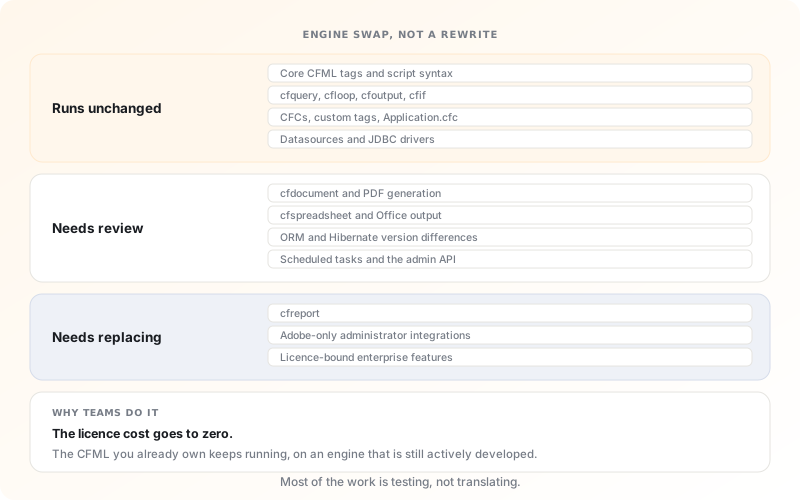
Three categories, and only one of them costs real money.
Lucee implements CFML. Core tags, script syntax, components, custom tags and datasource handling behave the way your application already expects, which is why a surprising amount of code moves with no edits at all.
The middle band is where the work sits. Document generation, spreadsheet output and ORM behaviour differ in details that matter, and those details tend to be in the parts of the system the business notices immediately, invoices, statements, exports.
The third band is small and specific: Adobe-only features with no Lucee counterpart. Finding them takes a scan, not a project, and the answer is usually a replacement library rather than a redesign.
The proportion is what makes this attractive. On most applications we assess, the first band is the overwhelming majority, and the estimate is dominated by regression testing, not development.
What changes on the invoice.
The licence saving is the headline, and it is usually not the only line that moves. We build this table with your real numbers during the assessment.
| Line | Adobe ColdFusion | Lucee |
|---|---|---|
| Engine licence | Per-server, per-version, recurring | None |
| Upgrade cadence | Driven by Adobe's support lifecycle | Driven by you |
| Adding an environment | Another licence to justify | Free; staging and test stop being a debate |
| Containerising | Licence model complicates it | Straightforward |
| Security releases | While the version is supported | Actively maintained project |
| Support | Adobe, plus your partner | Community, plus your partner |
| Migration cost | — | One-off: mostly regression testing |
Three reasons not to do this.
The first is procurement, not technology. Some organisations require a commercial vendor with a support contract behind anything in the critical path, and an open-source engine will not clear that bar however good it is. If that is your environment, this conversation ends here and there is no point in a proof of concept.
The second is the shape of your application. If you make heavy use of Adobe's document and reporting features, the middle band above stops being a detail and becomes the project. It is still often worth doing, but the estimate looks quite different and you should see it before deciding.
The third is timing. If you have already decided to migrate off CFML entirely and the work is funded and starting this year, changing engines first is effort spent on something you are about to discard.
If that migration is two or more years out, though, the calculation usually reverses: the licence savings across those years typically exceed the cost of the swap, and Lucee's more predictable Java interop makes the eventual move to the JVM easier instead of harder. The question is not whether you will leave CFML. It is what you are paying between now and then.
Five steps, run in parallel with the live system.
Nothing is switched until the same transactions produce the same results on both engines.
Written up in more depth on the blog.
The engineers who wrote these are the ones who would run your migration.
Adobe ColdFusion and Lucee.
The three that decide whether this is worth scoping.
Will our application really run without changes?
Most of it, and that is not the useful measure. The proportion of files that need editing is typically small, but the files that do need editing are rarely evenly distributed, they cluster in document generation, scheduled tasks, anything touching the administrator API and anything that has quietly depended on an Adobe-specific behaviour for years. This is why we run an automated scan first and then replay real transactions through both engines, not relying on a compatibility checklist. A checklist tells you which tags exist on both sides. Replaying your own transactions tells you whether your invoices come out identical, which is the question your finance team is asking.
Is Lucee a safe long-term bet?
It has been in production use for well over a decade, it is open source, and it is developed in the open with a commercial support ecosystem around it. Those are the structural things worth checking. The honest caveat is that the CFML world overall is shrinking, and moving to Lucee does not change that, the labour-market risk that brought you here is the same on either engine. What Lucee changes is cost and control: you stop paying per server, you upgrade when you choose rather than when a support lifecycle ends, and you can run as many environments as you actually need. Those are real benefits, and they are the right reasons to do it. Do it expecting to fix the hiring problem and you will be disappointed.
Could we run both engines permanently?
You can, and a few organisations do, but we would not recommend it as a destination. Running two CFML engines means two patching cycles, two sets of behaviour to test against and a permanent question about which one any given bug belongs to, and you keep paying the licence, so the main benefit never arrives. Running both in parallel during the transition is a different matter and is exactly how we do it: the Adobe instance stays live and serving while Lucee is proven against replayed transactions, and it stays available for a period after cutover so that rolling back is a routing change rather than an incident.