
Find out where AI pays, before you spend.
A short, evidence-based assessment of where AI creates value in your business, what your data and systems can support today, and what the first project should be, delivered as something you can put in front of a board.
A ranked answer, not a slide deck.
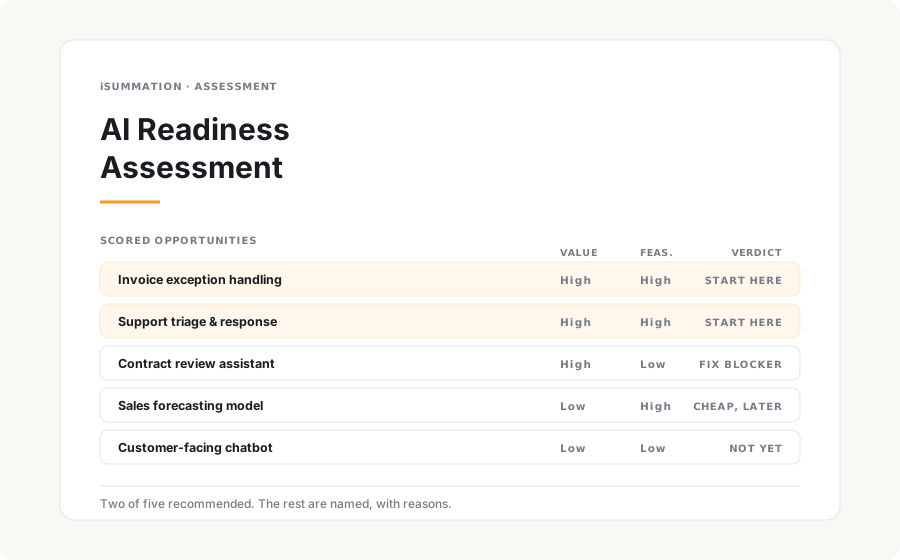
The deliverable is a written report with a scored opportunity register at the front. Each candidate carries a value score, a feasibility score and a verdict; including the candidates we recommend you do not attempt, with the reason stated.
It is written to be read by a finance director and a risk committee, not by engineers, and it is priced as standalone work. You can take it and build with someone else; it is deliberately usable that way.
Most failed AI projects were doomed at selection.
The projects that stall are rarely stopped by the technology. They are chosen badly: a use case with no measurable outcome, data that turns out to be unusable, a process the business was about to change anyway, or a sponsor who wanted a demonstration rather than a result.
By the time that becomes clear, a budget has been spent and the organisation has learned the wrong lesson, that AI does not work here.
An assessment is cheap insurance against that. Two to three weeks of structured enquiry produces a ranked, costed list of opportunities and, just as importantly, a list of the things that look attractive but should not be attempted yet.
We are a build firm, so there is an obvious conflict of interest in us writing that report. We manage it by saying plainly when the honest answer is that nothing here is worth building right now.
Where every candidate lands on one grid.
Value on one axis, feasibility on the other. The interesting argument is never about the top-right quadrant, it is about how much of your wish list sits in the bottom-right.
Fix the blocker first
Worth doing, not yet. Usually the data exists but is unreachable, or the system that must be written back to has no interface. The roadmap names the blocker.
Start here
A measurable outcome, accessible data, and a consequence of error the business can live with. Rarely more than two or three candidates land here.
Say no clearly
The quadrant that consumes budgets. Attractive in a workshop, expensive in delivery, and with nothing at the end anyone can point to.
Cheap, if you must
Easy to build and easy to justify politically. Fine as a demonstration; a poor choice for a first project that has to prove the case.
Six areas that decide whether AI will work here.
Readiness is not a maturity score out of five. It is a set of specific, checkable conditions, and the gaps are usually fixable once they are named.
Data availability
Does the data the use case needs exist, can it be reached programmatically, and is anyone allowed to grant that access?
Data quality
Completeness, consistency and history. A model cannot learn a pattern from eighteen months of records where half the fields were optional.
System integration
Whether the systems that must be written back to have usable interfaces, and what it costs to build one where they do not.
Governance and risk appetite
Who signs off an automated decision, what your regulator expects, and where the organisation genuinely will not accept a machine deciding.
Skills and operating model
Who runs this after go-live. A system nobody owns degrades quietly within two quarters.
Sponsorship and sequencing
Whether there is a sponsor with budget and patience, and whether this competes with a programme already consuming the same teams.
Three documents, written for people who will not build it.
The report has to survive contact with a finance director and a risk committee, so it is written for them rather than for engineers.
The opportunity register
Every candidate we examined, scored on value, feasibility, risk and adoption, with the evidence behind each score and a plainly worded list of what not to attempt yet.
Scored Ranked EvidencedThe readiness assessment
What your data and systems can support today, where the gaps are, and what each gap would cost to close, written from inspection, not from interviews.
Data Systems GovernanceThe costed roadmap
A sequence with dependencies, a recommended first project scoped to a fixed price, and a governance outline your risk function can review.
Sequenced Costed Fixed-price v1Three weeks, six to eight hours of your time.
-
Days 1–2
Frame the question
Agree scope, success criteria and who we need to speak to. You get a one-page terms of reference, signed off before anything starts.
-
Week 1
Interview across the business
Six to ten structured conversations spanning operations, finance, IT and the front line. Disagreements are recorded, not smoothed over; they are usually the most informative part.
-
Week 2
Inspect the systems
Engineers with hands on the actual data and systems, testing what the interviews described. This is the step that separates this from a strategy deck.
-
Week 3
Score and cost
Opportunities ranked, the top few costed properly, and a recommended first project scoped to a fixed price.
-
Week 3
Present and decide
A working session with your leadership team instead of a document sent by email, so the decision happens while everyone who needs to agree is in the room.
Before you commission an assessment.
The three below are the ones this page does not already answer. Anything more specific, put it to us directly.
You build AI systems. Why would your assessment ever say no?
Because our business depends far more on the projects we deliver working than on the number we start. An assessment that talks a client into an unwinnable project costs us a reference, a renewal and usually the relationship. We have written reports whose central recommendation was to fix a data pipeline for six months before attempting anything AI-shaped, and reports that concluded the client's real problem was a process design issue no model would solve. You are also free to take the report and build with someone else, it is written to be usable that way, and it is priced as a standalone piece of work.
We have already had a strategy deck from a consultancy. Is this the same thing?
Usually not, and the difference is in what gets touched. Strategy decks are typically built from interviews and market comparisons; they describe what is possible in your sector. This assessment additionally puts engineers in front of your actual data and systems, which is where most attractive-looking opportunities fail. If you already have a strategy document, bring it, we will test its recommendations against what your systems can support rather than duplicating the thinking.
What if we already know which project we want to do?
Then say so and we will scope that directly, not sell you an assessment you do not need. A full readiness assessment is worth it when the field is open or when several sponsors want different things. When there is one clear candidate, a short feasibility check on that single use case is faster, cheaper and answers the only question you have.