01Content audit
What material exists, where it lives, how current it is, and who may see it.
You getA content readiness report with the gaps named.
A general model knows everything except your business. We build systems grounded in your own documents, data and rules, so the answer is specific, cited, and respects who is allowed to see what.
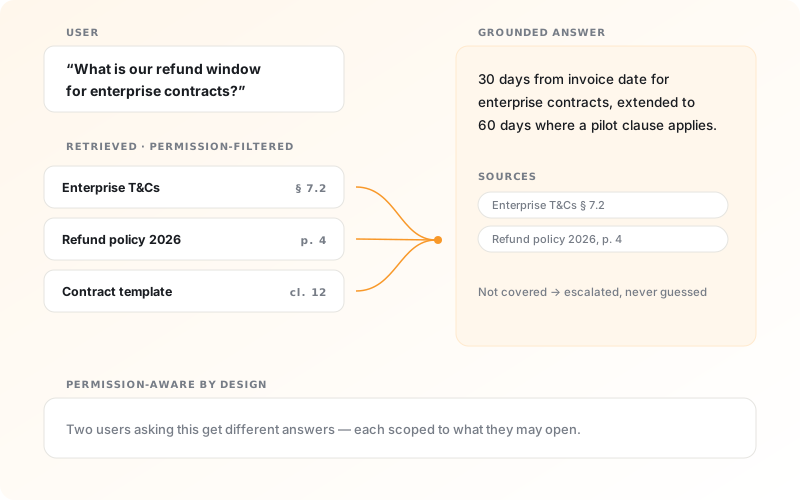
Any team can put a chat box in front of a language model in an afternoon. What makes it useful (and what takes the actual engineering) is everything behind it: getting your content into a form the model can search, retrieving the right passages, and constraining the answer to what those passages support.
Done properly, the result is a system that answers from your policies, your contracts and your product documentation, cites where each claim came from, and says it does not know when the material does not cover the question.
Done carelessly, you get a confident, fluent, unattributable answer that is wrong in a way nobody notices for three months. The gap between those two outcomes is retrieval quality, permission handling and evaluation, none of which are visible in a demo.
That is also why the second copilot is much cheaper than the first. The grounding layer, once built, serves every use case after it.
The model is one layer of five, and it is the one we expect to replace most often. Everything above it is what makes the answer yours.
Each is grounded in your own material and measured against questions your people ask.
Answer staff questions from policies, procedures and product material, with the source cited so the answer can be checked.
Intranet · SharePoint · policy libraryHandle product, order and account questions with a clean handover to a person the moment the conversation needs one.
Website · CRM · order systemDraft proposals, reports, responses and summaries from live data in your own house style, ready for review.
CRM · templates · data warehouseExtract obligations, dates and risks across large document sets, with every finding linked to its clause.
Document store · DMS · legal repositoryAssist with documentation, test generation and legacy code comprehension inside your own development workflow.
Repositories · CI · issue trackerSummarise conversations into decisions, owners and actions, written back to the system of record.
Conferencing · CRM · task toolsMost organisations have already deployed a chatbot and quietly watched usage collapse. The reason is almost never the model, it is that the bot could not see the information that would have made it useful, could not act on anything, and had no graceful exit when it was out of its depth.
We treat a chatbot as an interface onto a grounded system instead of a product in its own right. That means it can answer from your material, take real action where you allow it, and escalate cleanly with the conversation attached when it should.
The gap only appears in week three, which is why so many of these projects are approved on a demonstration and abandoned on contact with real questions.
Generative systems fail differently from ordinary software: they fail fluently. These are the controls that make that failure mode manageable.
An evaluation set built from your own questions and approved answers, run automatically against every change to prompts, retrieval or model.
Citations to the source passage on every claim. If a statement cannot be traced to your material, the system says so rather than filling the gap.
Retrieval inherits your existing permissions. Access is filtered before the model ever sees a passage, not afterwards.
Constrained generation over retrieved passages, confidence thresholds, and an explicit “not covered” response instead of a plausible guess.
Only if you choose that. Open-weight models can run inside your own tenancy; where a commercial API is acceptable we use zero-retention terms.
Per-query cost instrumented from the start, with caching, smaller models for routine retrieval, and ceilings per use case.
What material exists, where it lives, how current it is, and who may see it.
You getA content readiness report with the gaps named.Ingestion, chunking, indexing and permission filtering, the part that decides quality.
You getA working retrieval layer you can query directly.Interface, prompting, citation handling and escalation paths built on top.
You getA usable copilot in staging, on your real content.Scored against a question set written by the people who will use it.
You getAccuracy and coverage results, plus the list of content gaps found.Monitor unanswered questions, refresh content, tune retrieval, control cost.
You getMonthly usage, accuracy and cost reporting.The three below are the ones this page does not already answer. Anything more specific, put it to us directly.
No, and waiting until it is tidy is how these projects never start. Poor content shows up as specific, findable gaps once a copilot is running against it, the questions it cannot answer become a prioritised list of what needs rewriting, which is far more useful than a general instinct that the wiki is bad. We usually start with the material that is already reasonable, ship something useful, and let real usage direct the clean-up. What does need sorting first is permissions: if nobody can say who should see a document, the copilot cannot either.
Not if retrieval is permission-aware, which is the single most important design decision in a system like this. Access is applied when passages are fetched, before the model sees anything, so a user cannot retrieve material they could not open directly. The failure case to avoid is indexing everything into one store and filtering the answer afterwards, that leaks, and it leaks in ways that are very hard to detect. We inherit your existing groups and roles rather than inventing a parallel permission model that will drift.
Bundled copilots are useful inside the product they ship with, and where one covers your need we will say so instead of build you something. The limit is that they only see their own application's data. Most real questions cross systems; the contract in the document store, the order in the ERP, the conversation in the ticketing tool. That is where a custom grounding layer earns its cost, and it is also why we would rather complement what you already pay for than replace it.