From Inbox Chaos to Instant Orders: AI Document Intelligence for Automated Order Processing
High-volume order intake from a fragmented, low-tech vendor and customer base, solved with an LLM-powered document intelligence layer and AI-driven email gatekeeping, built into the client's Node.js API.
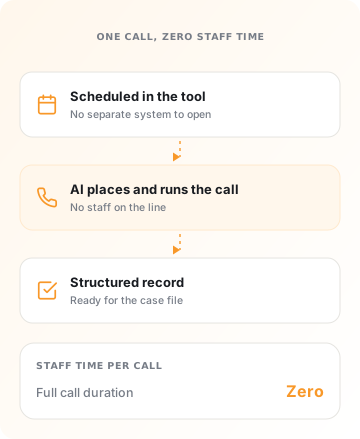
We built an LLM-based document-intelligence layer directly into the client's Node.js API, paired with an AI gatekeeper on an automated Gmail ingestion pipeline. Together, the two form a continuous, largely unattended pipeline from “email arrives” to “order is in the system, mapped to inventory.”
The Challenge
For most distribution businesses, digital transformation stops at the front door, because their customers and vendors never got the memo. This client's order pipeline was a case in point: almost none of their trading partners offered APIs or EDI integration. Every purchase order, order confirmation, shipment notice, and invoice arrived the old-fashioned way, buried in an email inbox.
That meant a staff member had to:
- Open every incoming email and figure out if it was actually an order (versus a newsletter, a shipping notification, or an email signature logo triggering a false positive)
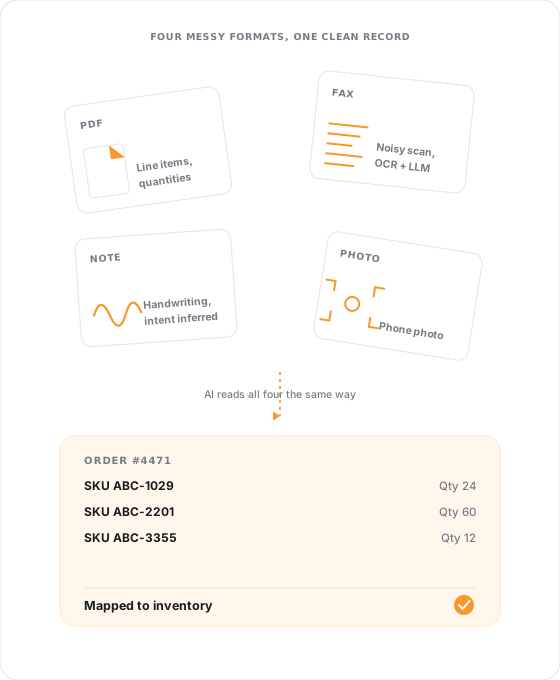
- Download and open each attachment - which could be a clean PDF, a scanned fax, a handwritten order form, or even a phone photo of a paper PO
- Manually read and key every line item - SKUs, quantities, sizes, descriptions - into the internal system, mapping it all to the client's own inventory codes
- Repeat this for 100+ line-item purchase orders, line by line, multiple times a day
The result was a slow, error-prone, and entirely human-gated bottleneck sitting between “customer sent an order” and “order is in the system”, one that didn't scale and couldn't run outside business hours.
The Solution
Together, the two form a continuous, largely unattended pipeline from “email arrives” to “order is in the system, mapped to inventory.”
AI Gatekeeper on the Gmail Pipeline
Classifies every incoming message, filtering out newsletters, logos, and delivery confirmations, so only genuine order-bearing emails reach the extraction pipeline. Runs continuously, no human triage required.
GMAIL · LLM CLASSIFIER · TRIAGEMulti-Format Document Intelligence
Clean PDFs, scanned faxes, handwritten forms, and phone photos are all read the same way, no special-casing, and mapped automatically to the client's own inventory codes.
PDF · OCR · HANDWRITING · PHOTOComputer Vision for Check & Payment Processing
OCR and computer vision handle check separation, MICR line reading, and image matching, automating another manual, paper-heavy workflow that previously required staff to sort and key data by hand.
OCR · MICR · IMAGE MATCHINGWhy This Approach Was Necessary
A traditional integration project would have meant building and maintaining custom parsers for every vendor's PO format, an ever-growing maintenance burden every time a new format appeared. LLM-based extraction sidesteps this: when a new PO layout shows up, the system handles it automatically, with no per-customer development required. That's the difference between building for the formats you know about today and building for whatever shows up in the inbox tomorrow.
Technical Approach
Core platform
Email pipeline
Document extraction
Computer vision
Inventory mapping
Results
- Time to process a 100+ line PO: from 20–40 minutes of manual typing to 5–15 seconds. Eliminated manual data entry as a bottleneck across the entire order intake process, regardless of how the order arrives.
- Order intake availability: from business hours, human-gated to 24/7, fully automated triage. Faster order-to-delivery cycle times, driven by near-instant order capture instead of hours of queued manual entry.
- New PO/vendor format handling: from custom development per format to handled automatically, no dev work. No scaling penalty for business growth, new customers, new vendors, and new document formats no longer require custom integration work.
- Wrong-item shipments from misread orders: from a recurring issue to significantly reduced. Fewer costly fulfillment errors, misread part numbers and sizes were a recurring source of wrong-item shipments before automation.
- Order-to-delivery speed: from bottlenecked by manual data entry to faster end-to-end fulfillment. Staff freed up from repetitive, low-value keying work to focus on exceptions, relationships, and higher-value tasks.